Ethics
Ethica, ordine geometrico demonstrata · 1677
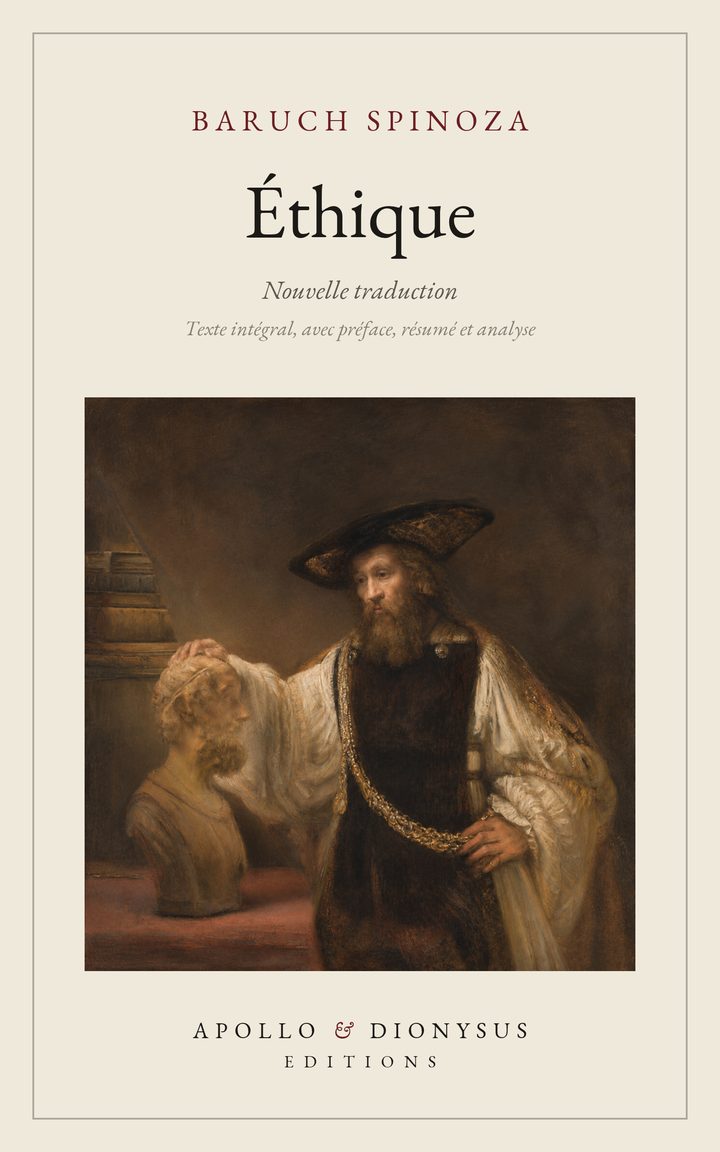
This edition of the Ethics includes:
- A new, previously unpublished translation by François Dante, made from the Latin text
- The complete text of the five parts of the work (1677)
- A note on the author
- An original literary preface by François Dante
- A detailed summary of each part
- An in-depth analysis of the work’s major ideas
- More than 2,000 words of original, previously unpublished editorial content
What does it mean to be free, when everything in nature obeys causes? And can we reach joy without expecting anything from another world?
The Dutch Republic, in the seventeenth century. Expelled in 1656 from the Jewish community of Amsterdam, Baruch Spinoza lives modestly by grinding optical lenses and devotes himself to philosophy. For more than ten years, he works on a book he will not publish in his lifetime.
He gives it an unheard-of form: to set out philosophy in the manner of geometers, through definitions, axioms, propositions and demonstrations. From this tight reasoning arises a thought that overturns received ideas: God is not a judge standing outside the world, he is Nature itself, the one substance of which every thing is a mode of being.
Across the five parts, Spinoza leads his reader from God to the human mind, then to the affects, to the bondage in which the passions hold man, and finally to the freedom that knowledge gives. Desire, joy and sadness are studied there with the rigor usually reserved for the figures of geometry.
Published in 1677, a few months after its author’s death, the Ethics was long held to be a dangerous book before becoming one of the major works of modern philosophy. In it Spinoza explores the nature of God, the power of the affects, human bondage and freedom, and the blessedness that is born of knowledge.
Presented by Apollo & Dionysus Editions, this English edition, in a new English translation by François Dante, is enriched with an original literary preface, a detailed summary and an analysis of the work’s major ideas.
A demanding and luminous book, which promises whoever follows it a freedom won by the sole strength of the intellect.
Ebook
€2.99
Buy
Available as an ebook only, for the time being.
The edition
- Languages
- Français · English (forthcoming) · Español (forthcoming)
- Translation
- Translated from the Latin by François Dante
- Contents
- Preface · About the author · Complete text · Summary · Analysis
- Formats
- Kindle ebook