On the Republic
De re publica · c. 51 BC
This edition of On the Republic includes:
- The complete text of all that has come down to us of the dialogue’s six books, in a new English translation by François Dante
- A word about the author
- An original literary preface by François Dante
- A detailed summary
- An in-depth analysis of the work’s major themes
- More than 3,000 words of original, previously unpublished editorial content
What is the best way to govern a city? And can a state endure if it is not founded on justice?
Rome, 129 BC. During the days of a festival, Scipio Aemilianus, the conqueror of Carthage, receives his friends in his gardens. Laelius, Philus, Manilius and a few young men gather around him. The conversation begins with a celestial phenomenon, then turns to public affairs.
Scipio defines the republic as the property of the people, examines kingship, aristocracy and democracy, and defends a mixed constitution in which each tempers the others, of which Rome seems to him the model.
The friends then debate justice: Philus argues, to put it to the test, that no state can do without injustice, and Laelius answers him. The work ends with the Dream of Scipio, in which Africanus appears in a dream to his grandson and shows him, from among the stars, the smallness of human glory.
Written by Cicero between about 54 and 51 BC, as the Roman Republic was coming apart, this dialogue has reached us only in part, rediscovered in the nineteenth century beneath another text in a Vatican manuscript. In it Cicero explores politics, law, justice and the duty of the citizen.
Presented by Apollo & Dionysus Editions, this English-language edition is enriched with an original literary preface by François Dante, a detailed summary and an analysis of the work’s major themes.
A reflection on the common good, written at the very moment it was threatening to disappear.
Ebook
€2.99
Buy
Available as an ebook only, for the time being.
The edition
- Languages
- Français · English (forthcoming) · Español (forthcoming)
- Translation
- Translated from the Latin by François Dante
- Contents
- Preface · About the author · Complete text · Summary · Analysis
- Formats
- Kindle ebook
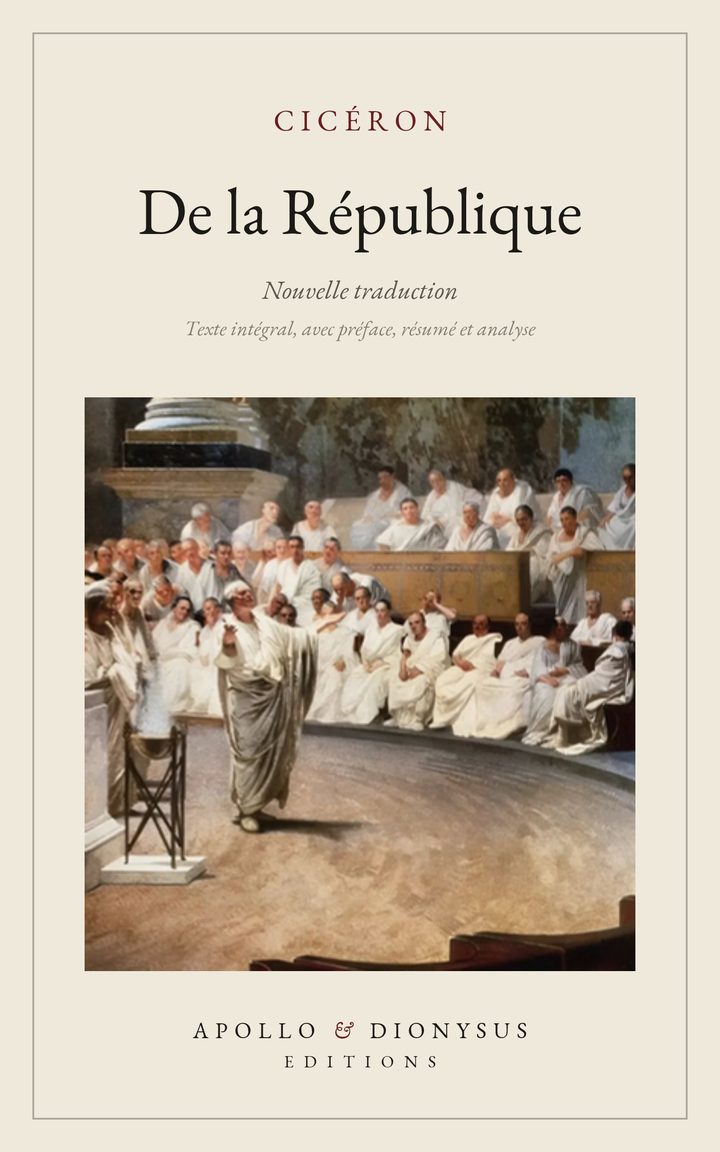
- Cover
- Cesare Maccari, Cicero Denounces Catiline, 1889